
Commercial Roof Repair Questions in Radcliff
Get Plain Answers on Leaks, Seams, Drains, and Permit Review
These are the commercial roof repair questions in Radcliff that building owners and facility managers bring up most, answered with the repair steps and county contacts behind them.
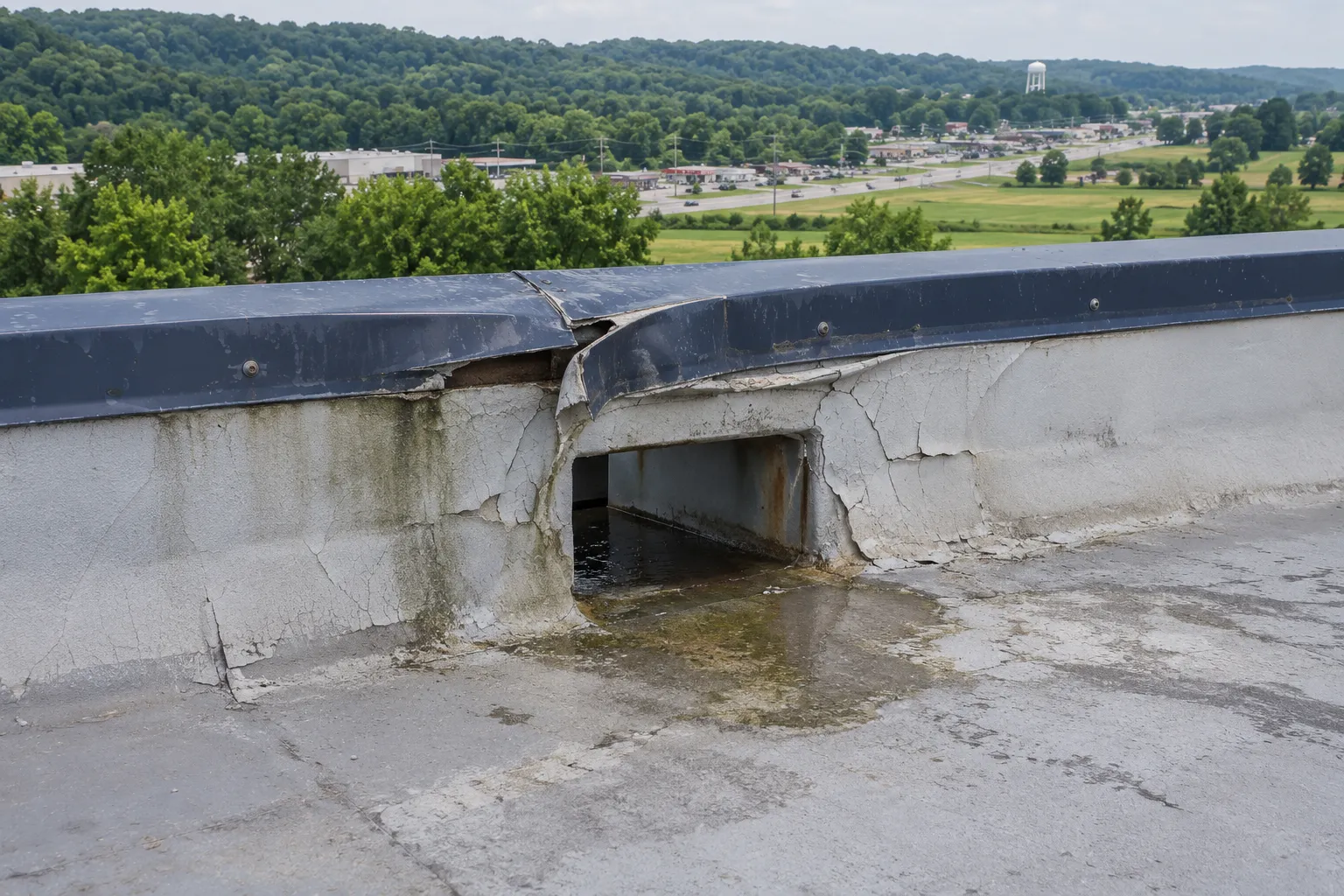
Commercial Roof Repair Questions in Radcliff, Answered
Each of these commercial roof repair questions in Radcliff comes from repair work on flat and metal roofs across Hardin County and the counties around it.
Commercial roof repair is the targeted fixing of failed seams, damaged flashing, worn metal and the leaks they cause on commercial, industrial and agricultural buildings. Radcliff Commercial Roof Repair repairs flat membrane and metal roofs in Radcliff, in Hardin County, Kentucky, and in the surrounding towns, from single leaks at a curb to storm damage across a plant roof.
Commercial Roof Repair Basics
What does a commercial roof repair contractor fix?
A commercial roof repair contractor fixes the specific parts of a roof that let water in, while leaving the working parts of the membrane or panels in place. Flat roofs and metal roofs fail in different spots and take different repair methods.
| Problem | Flat membrane roof | Metal roof |
|---|---|---|
| Open joints | Split or peeled seams, rewelded or retaped | Leaking side and end laps, resealed and restitched |
| Holes | Punctures and cuts, patched with matching membrane | Rust-through spots, patched or panel swapped |
| Penetrations | Curb, pipe and pitch pan flashing | Pipe boots, curb flashing, skylight panels |
| Water flow | Clogged drains, ponding, scupper leaks | Gutter seams, valley rust, overflowing outlets |
| Attachment | Loose edge metal, billowing sheets | Backed-out fasteners, lifted trim |
Each repair starts with confirming where the water actually enters, since the stain inside rarely sits under the hole.
Where do commercial roofs leak most often?
Commercial roofs leak most often at transitions, where the membrane or panel meets a curb, wall, drain, pipe or another piece of roofing. The open field of a roof holds up far longer than its edges and openings.
| Roof type | Common leak points |
|---|---|
| TPO and PVC | Unwelded seam spots, T-joints, curb corners, pipe boots |
| EPDM | Peeling lap seams, shrinkage at walls, split flashing corners |
| Modified bitumen and built-up | Blisters, cracked flashing, open laps at drains |
| Exposed-fastener metal | Screw washers, end laps, ridge caps, gutters |
| Standing seam metal | Seam ends, penetrations through the pan, skylight laps |
A walk of these spots after each storm season catches many leaks while they are still small.
Should a commercial roof be repaired, restored or replaced?
Repair fits a roof with a few defined problems, restoration fits a roof that is aging evenly but still dry underneath, and replacement fits a roof with widespread wet insulation or a failing deck.
| Path | Roof condition | Work involved |
|---|---|---|
| Repair | Local leaks at seams, curbs, drains or fasteners | Patch, reflash, reseal the problem spots |
| Restore | Dry insulation, worn surface, many small issues | Repairs plus a fluid-applied coating over the field |
| Replace | Wet insulation in large areas, deck rust, failed membrane | Remove and install a new roof system |
Core cuts and moisture readings decide between the paths. Restoration only makes sense when the insulation under the membrane is dry.
Why does a temporary roof repair need a permanent follow-up?
A temporary repair stops water fast with materials that hold for a short time, and a permanent repair uses matching materials installed the way the roof maker specifies.
| Feature | Temporary repair | Permanent repair |
|---|---|---|
| Purpose | Stop active water during wet weather | Restore the roof at that spot |
| Materials | Roof cement, tape, tarps, wet-surface sealant | Welded or taped membrane, new flashing, new fasteners |
| Surface prep | Minimal, often on a wet roof | Clean, dry, primed surfaces |
| Follow-up | Replaced once the roof dries | Checked at the next routine inspection |
Roof cement smeared on a TPO or EPDM seam blocks a proper weld or tape bond later, so crews remove it before the permanent repair goes on.
Radcliff Commercial Roof Repair Questions on Flat Roofs
What flat roof problems can be repaired?
Most flat roof problems at seams, flashing, drains and isolated punctures can be repaired, as long as the insulation beneath them is dry. Leaks that keep returning across wide areas point to a deeper problem.
Repairable flat roof problems include these.
- Open or peeling seams on TPO, PVC or EPDM.
- Punctures from dropped tools, hail or foot traffic.
- Cracked flashing at parapet walls and RTU curbs.
- Loose termination bars and lifted edge metal.
- Clogged or leaking drains and scuppers.
- Small blisters in modified bitumen and built-up roofs.
A moisture reading around each problem spot shows how far water has spread into the insulation before the patch goes on.
What fixes an open seam on a TPO, EPDM or modified bitumen roof in Radcliff?
Open seams get cleaned, dried and joined again with the method that matches the membrane, since each material bonds differently.
| Membrane | Seam repair method |
|---|---|
| TPO | Clean and prepare the weathered sheet, then hot-air weld or weld a cover strip over the open lap |
| PVC | Clean, then hot-air weld the lap or a cover strip |
| EPDM | Clean, prime, then apply seam tape and lap sealant at the edges |
| Modified bitumen | Heat or adhere the lap, then add a granulated cover strip |
Old TPO often needs a weatherworn-membrane cleaner before it accepts a weld. EPDM seams that peeled along their whole length point to failed splice adhesive and a wider seam repair program.
What causes blisters on a flat roof, and how are they repaired?
Blisters form when trapped moisture or air between plies or under the membrane expands in the sun, lifting a raised bubble. They show up most often on modified bitumen and built-up roofs.
Repair steps for a blister.
- Cut the blister open in an X pattern.
- Dry the exposed area and check the insulation beneath.
- Fold the flaps back down into fresh adhesive or heat.
- Cover the cut with a patch that runs well past its edges.
Intact small blisters are often watched instead of cut. Blisters that keep spreading point to wet insulation, which calls for core cuts before more patches go on.
Can ponding water on a flat roof be fixed with a repair?
Ponding at a clogged drain or a small low spot can be fixed with a repair, while ponding across whole bays usually comes from deck deflection or missing slope and needs tapered insulation.
Repair-level fixes for ponding.
- Clear debris from drain strainers, sumps and scuppers.
- Replace crushed drain strainers and loose clamping rings.
- Add a small tapered cricket behind an RTU curb that dams water.
- Build a sump around a drain that sits above the surrounding roof.
Standing water that lingers long after rain speeds up membrane wear and adds weight to the deck. Marking pond edges with chalk after a storm shows how big each pond really is.
How are punctures and splits patched in single-ply membrane?
Punctures and splits in single-ply membrane get a patch of the same material, rounded at the corners and adhered well past the damage on every side.
- TPO and PVC punctures get a welded patch after cleaning.
- EPDM punctures get a primed, taped patch with sealant at the edges.
- Splits along a fastener row get the loose fastener replaced before patching.
- Holes from hail get a probe check for cracked membrane over soft insulation.
A puncture over wet insulation gets the wet board cut out and replaced first. Patches set over damp insulation trap water and blister later.
Radcliff Commercial Roof Repair Questions on Metal Roofs
Why do metal roofs leak at screws, and how is fastener back-out repaired?
Metal roofs leak at screws when rubber washers dry out and crack, or when panel movement slowly backs the fastener out of the purlin and opens the hole. Exposed-fastener R-panel roofs on warehouses and shops show this most.
Fastener repair on a metal roof.
- Walk each screw row and mark loose, stripped or tilted fasteners.
- Replace backed-out screws with an oversized fastener and new washer.
- Drive replacements straight and snug, keeping the washer from crushing.
- Seal abandoned holes with a stitch screw and sealant.
Overtightened screws split washers just as aged ones do, so a light hand with the driver matters.
Why do metal roof end laps and side laps leak, and how are they repaired?
Leaking laps get cleaned, restitched and resealed, because rain runs uphill under an end lap by capillary action and seeps into the building at the purlin underneath.
- End laps get new butyl tape or sealant between the panels and stitch screws through the lap.
- Side laps get stitch screws at the spacing the panel maker calls for.
- Rusted lap edges get wire-brushed and primed before any sealant goes on.
- Laps on low-slope sections get a reinforced seam strip over the joint.
End laps near the eave carry the most water, so they get checked first on a leaking metal roof.
When does a rusted metal panel get patched, and when does it get replaced?
A rusted panel gets patched when the rust-through is small and the surrounding steel is firm, and it gets replaced when holes spread along the panel or the steel flakes away under a scraper.
| Panel condition | Repair |
|---|---|
| Surface rust, steel firm | Clean, prime and seal |
| Pinholes in a small area | Fabric-reinforced patch in compatible sealant |
| Holes larger than a hand | Metal patch screwed and sealed over the opening |
| Rust-through along a panel run | Panel replacement with new laps and fasteners |
Rust at the bottom end of a panel and inside end laps tends to run deeper than it looks, so crews probe those spots.
How are gutters, valleys and eave trim repaired on a metal building?
Gutters, valleys and eave trim get repaired by sealing open seams, patching rusted sections, and fixing slope or outlets so water stops sitting in them.
- Gutter seams get cleaned and resealed, with rivets replaced where loose.
- Rusted gutter bottoms get patched or the section swapped.
- Valleys get cleared of debris and sealed at the panel overlap.
- Eave trim gets refastened where wind has lifted it away from the panels.
- Downspout outlets get enlarged or cleared when gutters overflow.
Box gutters built into the roof edge leak into the wall when their seams fail, which makes them a priority on older metal buildings.
How are ridge caps, curb flashing and skylight panels repaired on a metal roof?
Ridge caps, curb flashing and skylight panels get repaired by replacing failed closures, resealing laps, and swapping cracked panels, since these details let in more water than flat panel areas.
- Ridge caps get new foam closures and stitch screws where wind-driven rain enters.
- Curb flashing at RTUs gets resealed, or rebuilt with a diverter on the high side.
- Skylight panels that crack or yellow get replaced with new panels matched to the rib profile.
- Pipe boots that split around the collar get replaced with a new boot.
Cracked skylight panels are also a fall hazard, so crews mark them before any repair work starts on the roof.
Commercial Roof Leak Repair Questions
How is a commercial roof leak traced to its source?
Roof leaks are traced by starting at the interior stain, mapping it to the roof above, and then checking every seam, flashing and penetration upslope of that point. Water travels along deck flutes, purlins and insulation joints before it drips.
- Mark the interior drip points and photograph them.
- Locate the same spot on the roof using columns, RTUs or skylights as reference.
- Inspect seams, curbs, drains and fasteners uphill of that spot.
- Probe seams and test suspect areas with a controlled water test.
- Use moisture readings to see how far water spread under the membrane.
Leaks that show only in wind-driven rain often come from wall flashing, coping caps or ridge caps.
Why does a roof leak show up far from the actual hole?
Water that gets through a roof often travels a long way across the deck or insulation before it finds a gap to drip through, so the ceiling stain can sit well away from the hole in the membrane.
Common paths water takes.
- Along the flutes of a steel deck to a low point or joint.
- Across insulation boards to the joint between two of them.
- Down a purlin or beam to a column line.
- Through a light fixture, conduit or sprinkler pipe opening.
Wet insulation along that path holds water and keeps dripping for days after the rain stops. Crews trace the path back uphill to the actual entry point on the roof.
What causes leaks at RTU curbs, pitch pans and pipe penetrations?
RTU curbs, pitch pans and pipe penetrations leak when the flashing around them cracks, pulls loose, or was installed too short for the roof height. These openings move with equipment vibration and temperature changes.
| Penetration | Common failure | Repair |
|---|---|---|
| RTU curb | Cracked corners, flashing pulled off the curb | Reflash with new membrane and corner pieces |
| Pitch pan | Shrunken or cracked filler | Clean, refill with pourable sealer, mound it |
| Pipe boot | Split boot or loose clamp | New pre-molded boot and clamp |
| Conduit or gas line | Bare pipe through the membrane | Move to a pipe support or add a proper boot |
Pitch pans need refilling over time, so a check of each pan belongs on every roof inspection.
How are leaking roof drains and scuppers repaired?
Leaking drains and scuppers get repaired by resetting the membrane under the clamping ring, replacing broken parts, and resealing the scupper box to the roof and wall. Water collects at these spots, so small defects leak quickly.
- Clamping rings get cleaned and retightened, with missing bolts replaced.
- Strainers get replaced when crushed or missing.
- Sumps get rebuilt where the membrane sags around the drain bowl.
- Scupper boxes get resealed at the wall and stripped in with membrane.
- Conductor heads and downspouts get cleared and resealed at their joints.
Drain repairs that reach the drain body or interior piping fall under plumbing review, so those go to the plumbing inspector on the county contact sheet.
What should a building owner do when the roof starts leaking?
When the roof starts leaking, protect people and stock inside first, then record the leak so the repair crew can trace it.
- Move inventory, equipment and electronics away from the drip.
- Set buckets or tarps and mark the spot on the floor.
- Photograph the ceiling stain and note the time, rain and wind direction.
- Keep people off the roof during storms and lightning.
- Clear drains and scuppers only when the roof is safe to walk.
Leaks near light fixtures, panels or wiring need the power to that area shut off by someone qualified before anyone touches them.
Still Have a Question About Your Own Roof?
Planning a Repair
Describe the roof and the problem spots to request an inspection.
Get A Free EstimateIndustrial Roof Repair Questions
What makes industrial roof repair different from other commercial roof work?
Industrial roof repair deals with larger roofs, heavier rooftop equipment, process exhaust and plant operations that keep running under the work. A single leak can drip onto production lines, electrical gear or stored product.
Factors that shape industrial repairs.
- Roof areas large enough that leaks spread far before they show inside.
- Exhaust from process stacks that attacks the membrane around curbs.
- Constant service traffic to fans, RTUs and make-up air units.
- Safety rules for hot work, lockout and fall protection.
Industrial repair crews plan around shifts and clean areas, and they coordinate roof access through the plant's safety contact.
How is roof damage around grease and chemical exhaust repaired?
Roof damage around grease and chemical exhaust gets repaired by cutting out the softened or swollen membrane, replacing it with a material that resists that discharge, and adding protection at the source.
- Identify what each fan or stack discharges onto the roof.
- Cut out damaged membrane down to firm substrate.
- Install a resistant membrane patch or a sacrificial layer around the curb.
- Add a grease containment box at kitchen and process fans.
- Clean the surrounding area so residue stops spreading.
Damage that keeps returning around a fan after repair points to a membrane mismatch across that whole roof zone.
How are industrial roofs repaired without stopping production?
Industrial roofs are repaired around production by scheduling noisy or odorous work for off-shift hours, protecting what sits under the work zone, and keeping roof access routes away from loading areas.
- Plant contacts mark sensitive zones such as clean rooms and electrical rooms.
- Air intakes near adhesive or hot-air welding work get shut or covered.
- Tarps go under any section where deck or insulation gets opened.
- Material lifts happen during breaks or in blocked-off yard areas.
- Daily work areas get closed and watertight before crews leave.
Most leak repairs on a plant roof happen entirely from above, with interior access needed only to confirm drip points.
How is wet insulation found on a large industrial roof?
Wet insulation on a large industrial roof is found with a moisture survey, which maps damp areas across the roof so repairs replace only the wet boards.
| Method | How it works | Fits |
|---|---|---|
| Infrared scan | Wet insulation holds heat after sunset and shows warm on camera | Large roofs with clear evenings |
| Capacitance meter | Reads moisture under the membrane in a grid | Roofs of any size, any time of day |
| Core cuts | Small samples taken through the roof | Confirming scan results at key spots |
Wet areas get cut out, replaced with new insulation, and covered with new membrane welded or taped to the surrounding roof.
What should a repair plan for a large plant roof include?
A repair plan for a large plant roof includes a roof map, a list of known problem areas, a schedule of inspections, and a record of every repair so patterns show up early.
- Roof map with drains, RTUs, stacks, skylights and walkway pads marked.
- Inspection schedule twice a year and after major storms.
- Repair log with dates, locations and materials used.
- Priority list ranking leaks over production lines and electrical rooms first.
A roof that keeps needing repairs in the same zones is a candidate for restoration or replacement of those sections.
Weather, Permits and Codes in Radcliff
Does a commercial roof repair need a permit in Radcliff?
Small patch and seal repairs often fall short of permit thresholds, while work that replaces roof deck, large membrane areas, structural framing, or rooftop equipment curbs brings in review. The local building official decides, so describe the scope plainly when calling.
Kentucky enforces the 2018 Kentucky Building Code, which builds on the 2015 International Building Code, according to the state's current code list.
Repair scopes that call for a permit question.
- Deck replacement under a leak.
- Large membrane tear-out and reinstallation.
- RTU curb rebuilds or equipment moves.
- Drain body changes that touch interior piping.
Who reviews commercial roof repair work in each town?
Repair work that needs review goes to the local building inspector that each county's state contact sheet lists, and the right office follows the county and city where the building stands.
| Town | County sheet | First office to contact |
|---|---|---|
| Radcliff | Hardin | City of Radcliff, under the Elizabethtown, Radcliff and Hardin County listing |
| Vine Grove | Hardin | Vine Grove local inspector, listed on its own |
| Muldraugh | Meade | Muldraugh city hall, then Meade County inspector |
| Brandenburg | Meade | Meade County inspector (Brandenburg is the county seat) |
| Irvington | Breckinridge | Breckinridge County inspector |
| Hardinsburg | Breckinridge | Breckinridge County inspector |
| Lebanon Junction | Bullitt | Lebanon Junction city hall, then Bullitt County inspector |
Each office comes from the state contact sheet for Hardin, Meade, Breckinridge or Bullitt County.
What should be checked on a commercial roof after a hailstorm or high wind?
After hail or high wind, check the roof for punctures, cracked membrane, lifted edge metal, displaced panels and damaged skylights, and photograph everything before repairs begin.
- Membrane surfaces get probed for fractures over soft spots.
- Edge metal and coping caps get checked for lift or loose fasteners.
- Metal panels get checked for dents at laps and opened seams.
- Skylight panels get checked for cracks and holes.
- Drains and gutters get cleared of hail and debris.
Insurance adjusters often want photos taken before any repair. Interior ceiling checks under the damaged areas confirm whether water already got in.
How does winter and spring weather around Radcliff cause new roof leaks?
Freeze-thaw cycles, ice at drains and heavy spring rain open small defects into active leaks around Radcliff. NWS Louisville's 1991-2020 normals for the Louisville station list 48.3 inches of yearly precipitation, with 13.4 inches falling as snow.
| Season | Common new leaks |
|---|---|
| Winter | Ice-blocked drains and gutters, split flashing at curbs, cracked sealant |
| Late winter thaw | Meltwater backing up under end laps and ridge caps |
| Spring storms | Wind-driven rain at coping caps and walls, hail punctures |
| Summer | Heat-cracked sealant, blisters on built-up roofs |
A roof check in late fall clears drains and reseals small gaps before ice sets in.
Cost, Value and Taxes
What affects the cost of a commercial roof repair?
The cost of a commercial roof repair depends mostly on how much wet material has to come out, how hard the leak is to reach, and how many spots need work.
- Size and number of leak areas.
- Wet insulation found under the membrane.
- Roof access, including lifts, ladders and roof hatches.
- Membrane type and the matching materials needed.
- Flashing complexity at curbs, walls and drains.
- Work-hour limits around building operations.
A leak traced to one open seam costs far less to repair than one that has soaked a whole bay of insulation, which is why fast reporting of leaks matters.
How do owners compare repeated repairs against restoration or replacement?
Owners compare by tracking repair history, mapping wet insulation, and weighing how much of the roof still works against how much keeps failing.
| Sign | Points toward |
|---|---|
| Few leaks, dry insulation, isolated causes | Continued repair |
| Many small leaks, dry insulation, worn surface | Restoration |
| Wet insulation across large areas | Replacement of those sections or the whole roof |
| Same seams and curbs leaking repeatedly | Rebuild of those details |
A moisture survey and repair log give owners the facts they need for that comparison.
Can commercial roof repairs qualify for Section 179?
Roof improvements to existing nonresidential buildings can qualify for Section 179, according to IRS Publication 946, and whether a given repair gets expensed or capitalized is a question for a CPA. The 2026 maximum deduction is $2,560,000, with phase-out starting once qualifying property passes $4,090,000.
Questions to bring to a CPA.
- Whether the work counts as a repair or a roof improvement.
- How large membrane or deck replacements get classified.
- Invoice wording that separates repair work from new roof sections.
The answer depends on each business's tax situation, so a CPA makes the final call.
Questions by Town
Which inspectors review structural roof repairs on Radcliff buildings?
Structural roof repairs in Radcliff, such as deck replacement or RTU curb rebuilds, start with the City of Radcliff, which shares a listing with Elizabethtown and Hardin County on the state's Hardin County sheet. State HVAC and electrical inspectors appear on that sheet too.
- Deck sections replaced under a leak go to the local building inspector.
- RTU disconnects and reconnects bring in the state HVAC inspector.
- Rewired rooftop lights or fans bring in the state electrical inspector.
Simple membrane patches and fastener replacement rarely need review, though owners confirm with the city before larger work.
What review applies to roof drain repairs on Radcliff buildings?
Drain repairs that stay at the roof surface, such as a new strainer or clamping ring, stay part of the roofing work, while repairs to the drain body or interior piping fall under plumbing review. The state's Hardin County sheet lists the plumbing inspector office at the Hardin County Health Department.
- Strainers and clamping rings are roof-level repairs.
- Drain body replacement falls under plumbing review.
- Leader pipe repairs inside the building fall under plumbing review.
- Scupper and downspout repairs outside stay with the roofing scope.
Knowing the split up front keeps drain repairs moving.
How do Vine Grove owners track storm warnings before roof repairs?
Vine Grove owners and roof crews get severe weather alerts from NOAA Weather Radio transmitter KZZ64 at Ekron, broadcast on 162.450 MHz by the Louisville office of the National Weather Service and covering Hardin County.
Before scheduled repair work, crews check the forecast for storms during work hours, cover open areas at the end of each day, and leave the roof when a warning comes in.
After a storm passes, Vine Grove owners look over membrane seams, flashing, edge metal and skylight panels, then call for a repair check. Roof repairs inside city limits that need review go to Vine Grove's own local inspector.
Who reviews structural roof repairs in Muldraugh?
The Meade County local building inspector reviews structural roof repairs in Muldraugh, a Meade County city that sits right at the Hardin line. The city has its own elected officials, so owners check with city hall about any city rules.
Repairs worth a call to the county office include these.
- Deck replacement under a leak.
- Structural framing repairs at a sagging section.
- Large membrane sections cut out and replaced.
- RTU curb rebuilds at a new roof height.
A short call to the county inspector settles whether smaller patch work needs review.
Which co-op should Brandenburg owners call before repairing a leak near a service mast?
Meade County RECC, headquartered in Brandenburg, is the first co-op to check for Brandenburg buildings, since it serves Meade County and its office sits in town. Owners confirm by checking the provider on the electric bill.
Leaks around a service mast or weatherhead on a roof need care, because the line feeding the mast is live.
- Keep crews and tools clear of the mast and drop.
- Call the co-op if the mast leans or the flashing around it needs removal.
- Reseal the boot or flashing only after the co-op confirms it is safe.
Brandenburg repair permits for larger work go to the Meade County local building inspector.
Which state inspectors cover RTU curb repairs in Irvington?
Irvington sits in Breckinridge County, and the state's Breckinridge County sheet names separate state inspectors for HVAC, plumbing and electrical work, apart from the ones serving Hardin County.
When an RTU curb leak repair means lifting or disconnecting the unit, the HVAC work goes to the Breckinridge state HVAC inspector. Drain body repairs go to the state plumbing inspector on that sheet.
When roofing repairs need review, the county's local building inspector takes them. Owners also check with Irvington city hall for electrical permits, which the sheet routes through the county or city office.
What should Hardinsburg owners know about roof deck repairs in the county seat?
As the Breckinridge County seat, Hardinsburg sends roof deck repairs to the county's local building inspector, because the state sheet gives the city no inspector of its own.
Deck repairs on Hardinsburg commercial buildings involve these steps.
- Cut out wet insulation and membrane above the damaged deck.
- Check the deck from inside for rust, sag or rot.
- Replace the deck section and fasten it to the structure.
- Install new insulation and membrane tied into the surrounding roof.
Owners call the county inspector before the deck comes out, since structural work often needs review.
Who reviews roof repairs on state-regulated buildings in Lebanon Junction?
Lebanon Junction roof repairs start with city hall and the county's local building inspector, listed on the state's Bullitt County sheet, while state-regulated buildings can bring the Kentucky Department of Housing, Buildings and Construction in directly.
Mount Washington's building department, also in Bullitt County, refers hospitals, nursing homes, daycares and other institutional or state-licensed buildings to the state. Roof repairs on buildings like those in Lebanon Junction that touch structure or rooftop equipment get checked with the state agency.
For other commercial buildings in Lebanon Junction, owners call city hall first, then the county inspector for larger repairs such as deck replacement or curb rebuilds.
Which smaller communities around Radcliff does repair service reach?
Repair service also reaches Ekron, West Point, Rineyville, Payneville, Guston and McDaniels, and each town follows its county's contact sheet.
| Town | County | Where repair review starts |
|---|---|---|
| Ekron | Meade | Meade County inspector |
| West Point | Hardin | West Point city hall, then Hardin County |
| Rineyville | Hardin | Hardin County office |
| Payneville | Meade | Meade County inspector |
| Guston | Meade | Meade County inspector |
| McDaniels | Breckinridge | Breckinridge County inspector |
Repairs in these towns follow the same leak tracing, patching and flashing methods as in Radcliff, with drains, seams and fasteners checked on every visit.
Getting Started
What information helps a repair crew find a leak faster?
Leak details collected before the crew arrives help them trace the source faster.
- Photos of interior stains and drips with dates.
- Weather during the leak, including wind direction.
- Roof type, age and any past repair records.
- Access details for the roof hatch or ladder.
- Locations of RTUs, skylights and drains near the leak.
Crews then walk the roof, check seams, flashing, drains and fasteners upslope of the leak, and take moisture readings around the area.
How is a commercial roof repair visit run, from first walk to final check?
Radcliff Commercial Roof Repair follows the same order on every repair visit.
- Inspect your roof, starting at the interior leak point.
- Trace the water path to the entry point on the roof.
- Take moisture readings around the area.
- Make a temporary repair if rain is coming.
- Complete the permanent repair with matching materials.
- Recheck drains, seams and flashing near the repair.
- Record the repair with photos for the owner's file.
Sources for These Answers
- Kentucky Department of Housing, Buildings and Construction, Find Currently Enforced Code
- Kentucky Department of Housing, Buildings and Construction, Hardin County contacts
- Kentucky Department of Housing, Buildings and Construction, Meade County contacts
- Kentucky Department of Housing, Buildings and Construction, Breckinridge County contacts
- Kentucky Department of Housing, Buildings and Construction, Bullitt County contacts
- City of Muldraugh, Elected Officials
- City of Mount Washington, Building and Housing
- Big Rivers Electric, Meade County Rural Electric Cooperative Corporation
- National Weather Service Louisville, 1991-2020 climate normals for Louisville
- National Weather Service Louisville, Ekron NOAA Weather Radio
- IRS Publication 946, How To Depreciate Property
More Commercial Roof Repair Questions in Radcliff? Call Us
Call with a question about your own roof, or request a free estimate and an inspection of the problem spots.