If Your Roof
A Few Open Seams on an Otherwise Dry Roof
Laps peel at T-joints or along one run, and readings around them stay dry.
Start WithSeam Repair

As a Radcliff flat roof repair contractor, we repair TPO, EPDM, PVC, modified bitumen, and built-up roofs at seams, flashing, blisters, punctures, and drains.
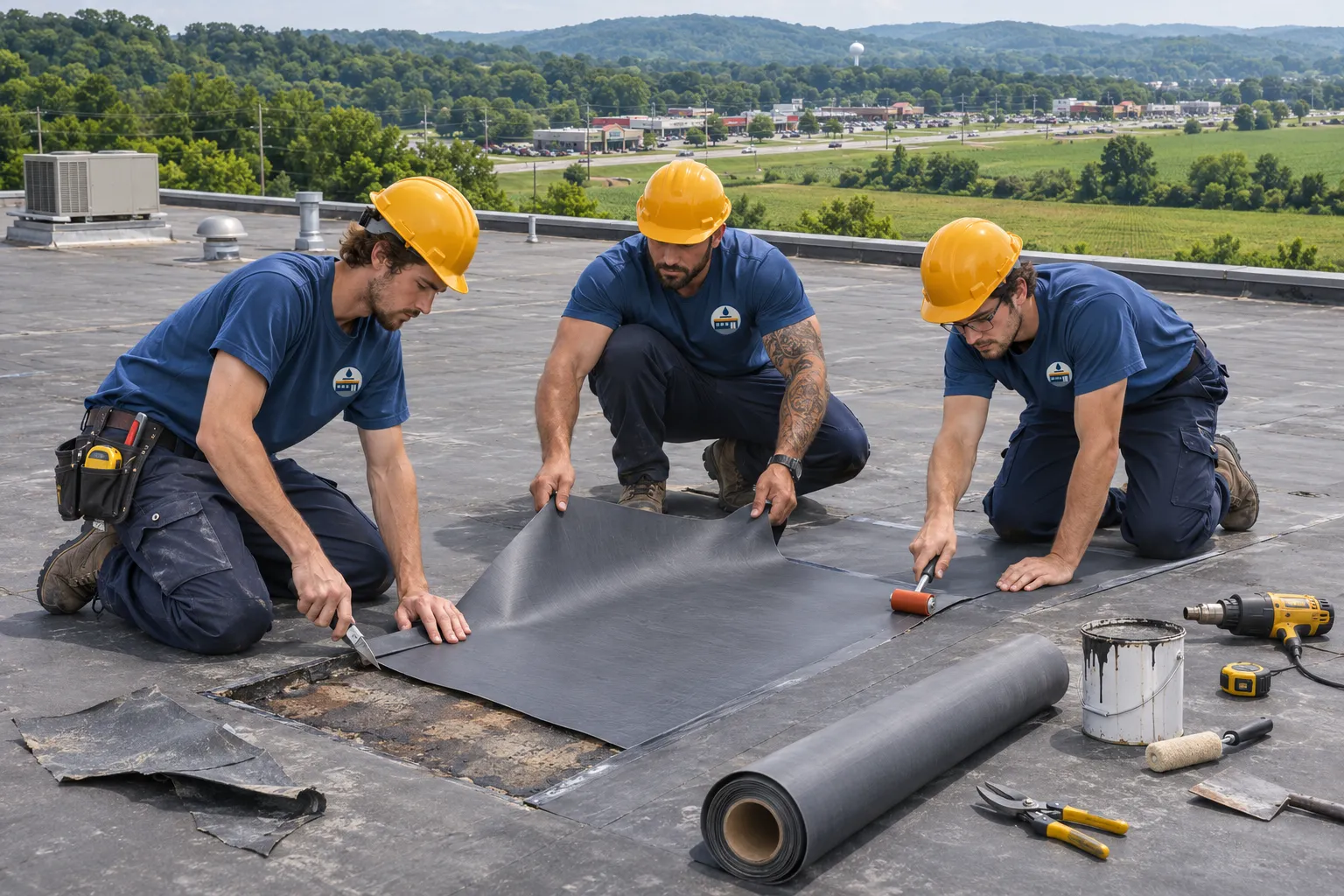
A Radcliff flat roof repair contractor sorts the roof into one of these situations first, because dry insulation decides how much can be patched.
Laps peel at T-joints or along one run, and readings around them stay dry.
Raised bubbles form where trapped moisture expands in the sun.
Standing water collects at a clogged strainer or where a curb dams the flow.
Readings show damp board well beyond the leak points, often under large ponds.
These flat roof conditions bring most repair calls, from ones to record and watch to ones that need a call today.
TPO and PVC laps open at unwelded spots and T-joints, and EPDM laps peel where splice adhesive fails. Rain runs straight under the sheet.
Dropped tools, foot traffic, and hail leave cuts that let water into the insulation. Hail holes get a probe check for cracked membrane over soft board.
Small intact blisters are often watched instead of cut. Blisters that keep spreading point to wet insulation and call for core cuts first.
Wall flashing shrinks and splits at the corners, and the leak shows up in wind-driven rain more than in a calm storm.
Debris in strainers and gaps under clamping rings put water exactly where the membrane has the most joints.
Water that lingers long after rain speeds up membrane wear and adds weight to the deck below it.
Each membrane bonds a different way, so the repair method follows the roof that is already there.
| Membrane | Seam Repair | Patch Method | Watch For |
|---|---|---|---|
| TPO | Clean the weathered sheet, then hot-air weld the lap or a cover strip | Welded patch with rounded corners | Old TPO often needs a weathered-membrane cleaner before it takes a weld |
| PVC | Clean, then hot-air weld the lap or a cover strip | Welded PVC patch | Older sheets can turn brittle near edges and corners |
| EPDM | Clean, prime, then apply seam tape with lap sealant at the edges | Primed, taped patch | Peeling along a whole seam points to failed splice adhesive |
| Modified bitumen | Heat or adhere the lap, then add a granulated cover strip | Torch-applied or cold-applied patch past the damage | Blisters that spread mean wet plies |
| Built-up | Cut out and dry the damaged plies | Layered felt and bitumen patch | Cracked flashing at drains and walls |
A flat roof repair aimed at the failed spot keeps the dry membrane in service and the building running underneath.
Rain finds the unwelded spot at the corner where three sheets meet.
A cover patch welded over the joint seals it while the rest of the roof stays in place with no tear-off.
Water pools at the drain and slips under the loose membrane edge.
Resetting the membrane under a clean, fully bolted ring stops the leak and keeps water leaving the roof on its normal path.
A small cut over soft insulation keeps feeding water into the deck.
Cutting out only the wet board and patching over dry insulation limits waste and keeps the patch from blistering later.
EPDM pulls away from the parapet and opens at the corners.
New flashing and termination bar rebuild the wall detail where wind-driven rain was getting in.
Call us and say which drain or wall the water is near. Keep people off the roof while it storms.
Call UsSend the roof type and the spots that leak so the inspection covers the right laps and drains.
Get A Free EstimateEach flat roof visit follows this order, starting inside under the leak.
We mark the drip inside, photograph it, then walk the roof above and check laps, T-joints, curb corners, and drains upslope of that spot.
A seam probe finds open laps that look closed, and a moisture meter around the problem area shows whether the board underneath is still dry.
Any wet insulation under the repair comes out and new board goes in, since a patch set over damp insulation traps water and blisters later.
The seam or patch is joined with the method that matches the sheet: hot-air welding for TPO and PVC, primer and tape for EPDM, heat or adhesive for bitumen.
Strainers, clamping rings, and scuppers near the repair get cleared and tightened, and photos of the finished spot go into your building record.
Flat roofs often share a building with metal sections or rooftop equipment that needs its own repair.
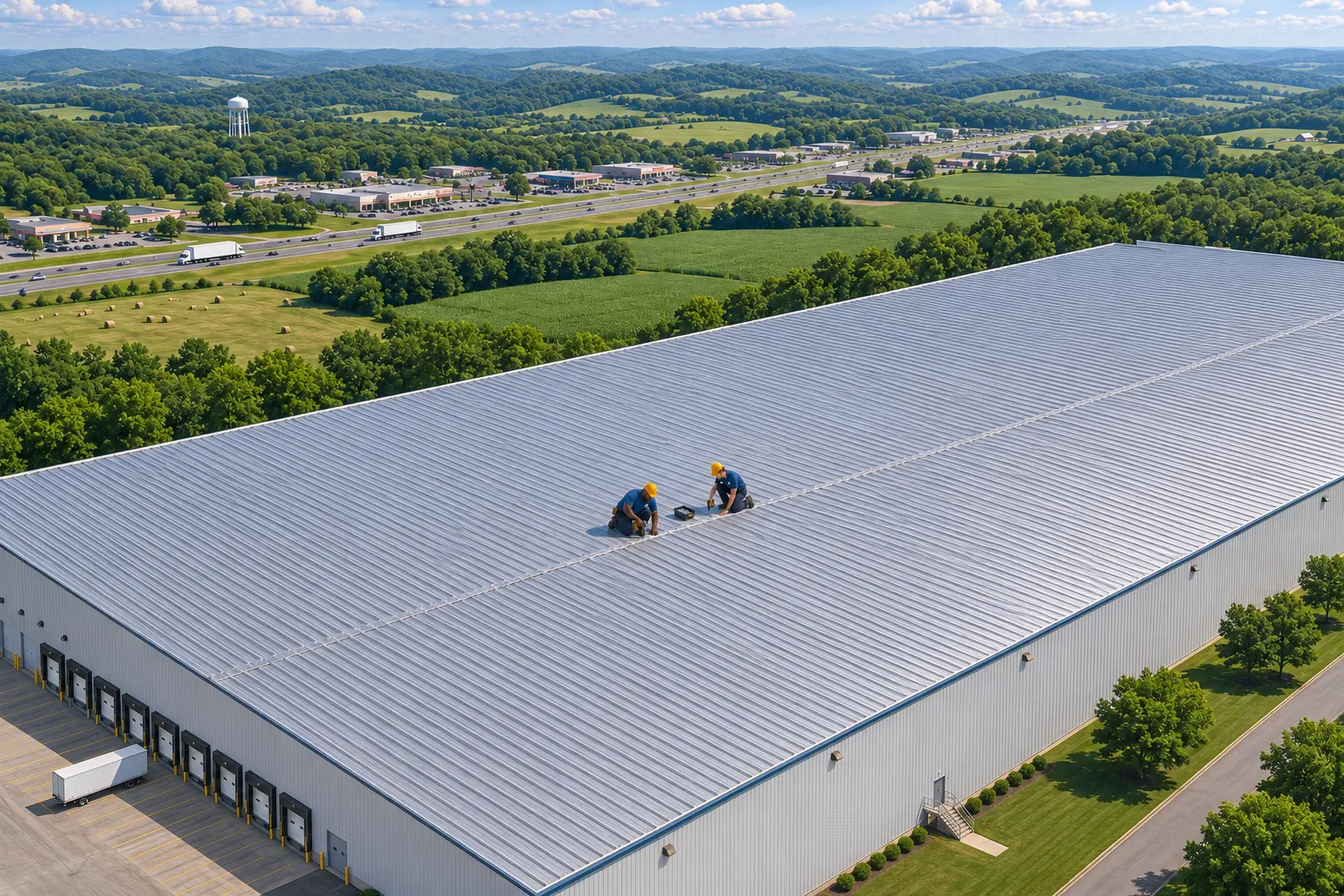
Shop and warehouse sections with exposed-fastener panels leak at screws and end laps, which take a different repair than a membrane seam.
Commercial metal roof repair →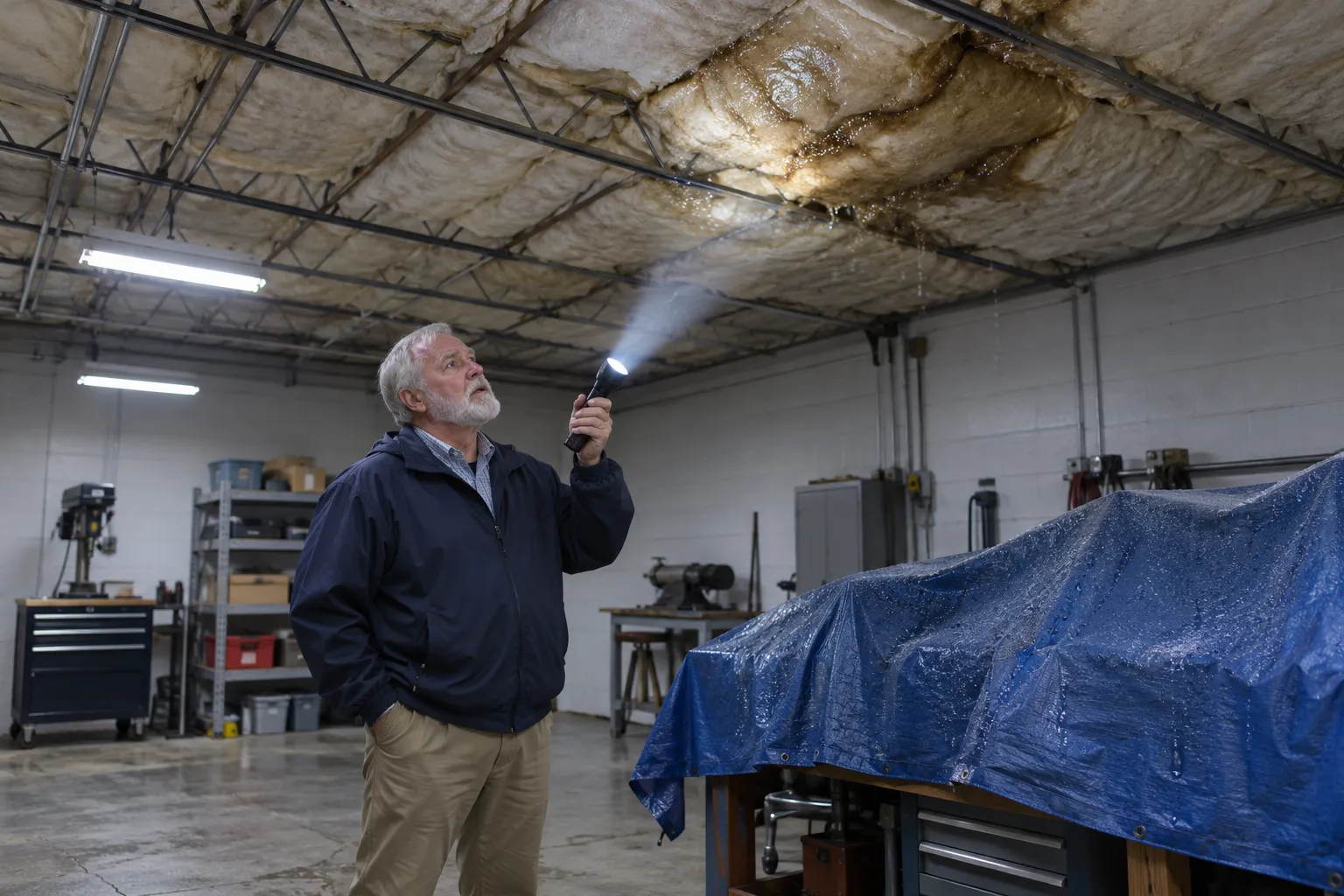
When the stain inside lines up with no obvious damage, leak tracing finds the entry point before anything is patched.
Commercial roof leak repair →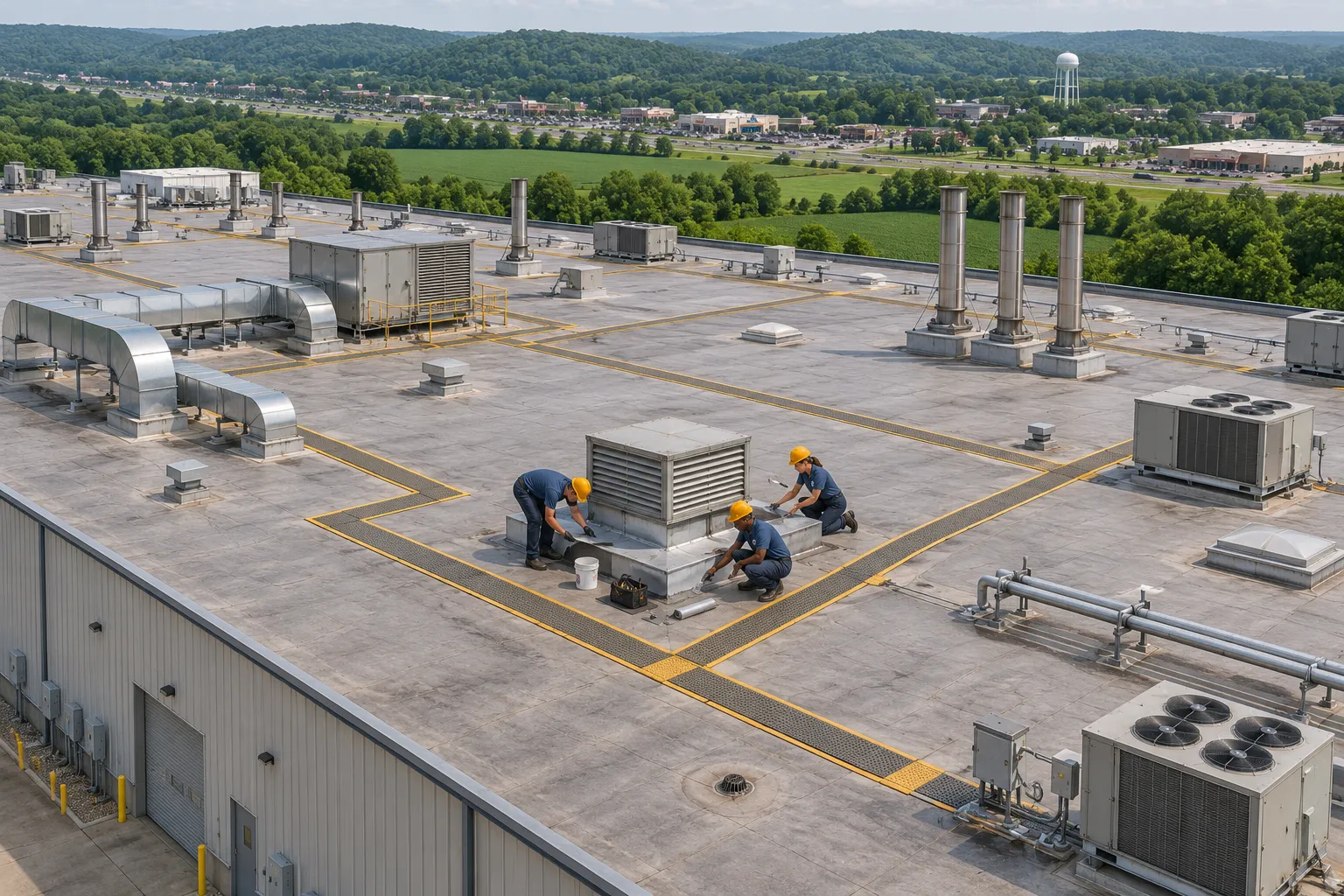
Plant roofs with exhaust fans and heavy units need repairs planned around production and the plant safety contact.
Industrial roof repair →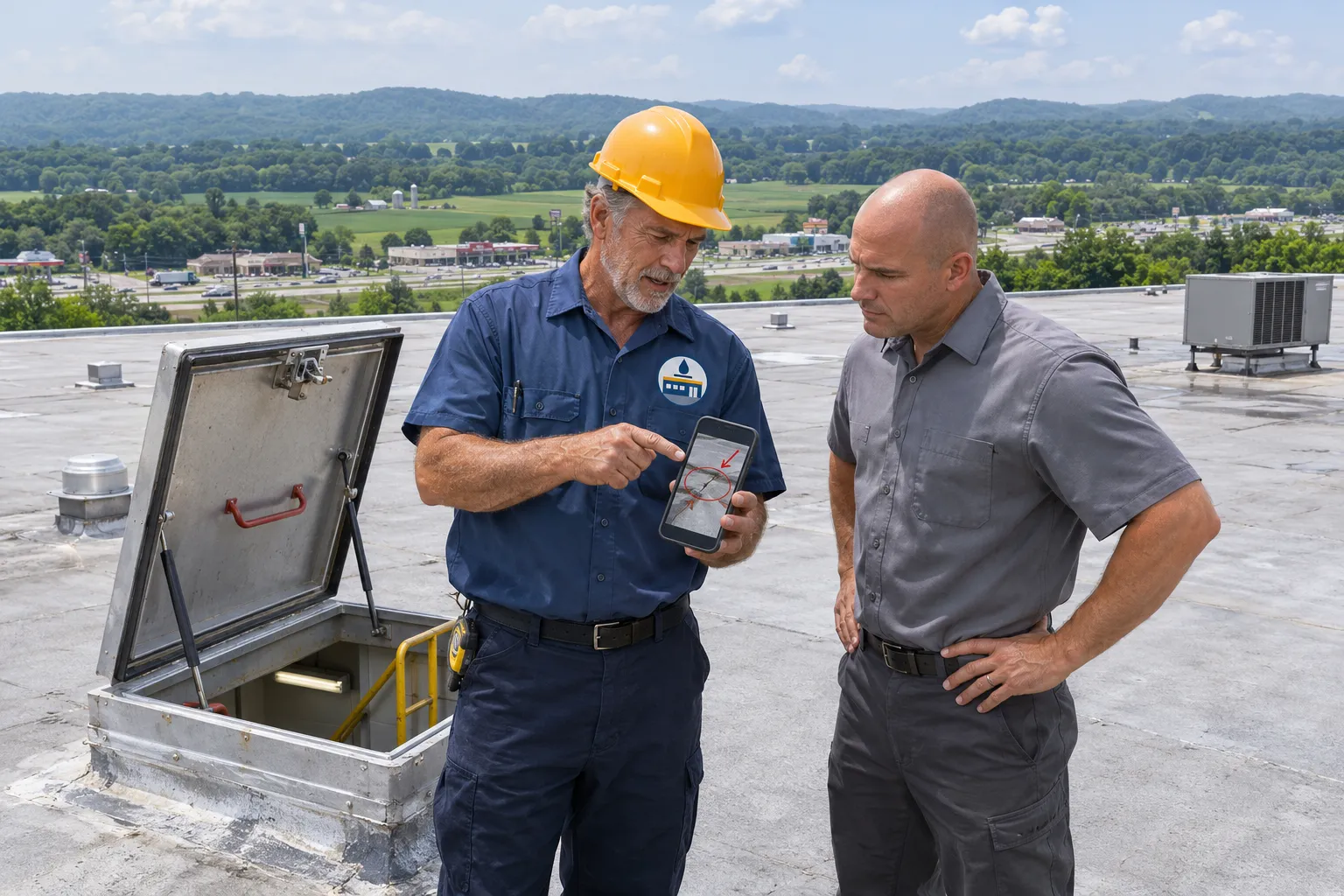
Question about your own roof?
Call UsMost problems at seams, flashing, drains, and single punctures can be repaired as long as the insulation under them is dry. That covers open laps on TPO, PVC, and EPDM, hail and tool punctures, cracked parapet and curb flashing, loose termination bars, clogged drains, and small blisters.
Leaks that keep coming back across wide areas point to a deeper problem in the insulation.
The fix follows the membrane. TPO gets a weathered-membrane cleaner and a hot-air weld, or a welded cover strip. EPDM gets cleaned, primed, and joined with seam tape and lap sealant. Modified bitumen gets heated or adhered and covered with a granulated strip.
An EPDM seam peeling along its whole length means the splice adhesive failed, which calls for a wider seam repair.
Blisters start when moisture or air trapped between plies expands in the sun and lifts the surface. To repair one, it gets cut in an X, the area is dried and the board checked, the flaps are folded into fresh adhesive or heat, and a patch covers the cut well past its edges.
Small intact blisters are often left alone and watched.
Yes, when the pond sits at a clogged drain or one small low spot. Clearing strainers, replacing a crushed strainer or loose ring, building a sump at a high drain, or adding a small cricket behind a unit solves those.
Ponding across whole bays comes from deck deflection or missing slope and needs tapered insulation instead of a patch.
With a patch of the same membrane, rounded at the corners and stuck down well past the damage on every side. TPO and PVC patches are welded, and EPDM patches are primed and taped with sealant at the edges.
A split along a fastener row gets the loose fastener replaced first, and wet board under a puncture is cut out before the patch.
Send the roof type, the leak spots, and how to reach the roof, or call to talk through the seams and drains giving you trouble.
Leave a name and number and we will call you back.
Prefer to talk now? Call (930) 201-5321